Wednesday, October 16, 2013

Williamson's Great Fall Fair


Nathaniel Williamson (SC WIL 1)


Irish immigrant Nathaniel Williamson was owner of Williamson's Store, "Idaho's Price Maker and Pace Setter". Williamson's Store was located in the McConnell Building, occupying all three floors plus units in an adjoining building, with goods ranging from furniture, ladies' wear, millinery and dressmaking, to men's wear, dry goods and shoes. Units in the adjacent building housed a restaurant, grocery and hardware store (LCHS Quarterly Bulletin, Vol. 5. No. 3, 1976, "Williamson's Store" by Frank Williamson & Dick d'Easum 15-23).

Williamson's Store had been preceded by The Boston store and then The Greater Boston store. With the culmination of his store's expansion, Williamson's was the only store with a passenger elevator, and an electric sign that was almost the full height of the building. The glowing ornament at the top of the sign was "visible from the summit of Viola grade and became a landmark of Moscow" (Williamson & d'Easum, 17). The second and third floors of the store were open, looking down to the ground floor. Taking advantage of the open area, Williamson's installed a large tree every Christmas that would occupy the height of the space. Contests were held to determine the height of the tree.

Nathaniel's showmanship extended to his advertising as well. "Business [at Williamson's] was brisk, particularly at special events he whooped up for the Fourth of July, fall fairs and January white sales. Fairs at The Boston were the forerunner of the Latah County Fair. He staged street parades, gave prizes for vegetalbes, flowers and horses, and conducted contests for old and young" (Williamson & d'Easum, 17). The first of the "Great Fall Fairs" began around 1908, with the expansion of the Boston Store into The Greater Boston ("A Great Good Country" by Lillian Otness, 30).

Great Fall Fair, Williamson's Store can be seen on the right. (LCHS 01-02-47)

(LCHS 25-10-05)
(LCHS 25-10-01)

(LCHS 25-10-03)
Nathaniel Williamson was one of the area's early entrepreneurs. After closing the Williamson store, he bred pedigreed cattle and operated several farms and farm related businesses.

Friday, October 11, 2013

Artifact Spotlight: The Unofficial 39 Star Flag


This flag came in to our office as part of a recent donation from the former owner of the M.J. Shields Building in downtown Moscow.  Can you figure out why this flag is unique?


At first glance, this might look like a rather unremarkable 19th century American flag.  In fact, with its notable signs of deterioration, I was initially hesitant to accession it into our artifact collection.  Upon attempting to date the flag, however, I realized that we had a curious piece of history on our hands.  With its 39 stars, this is actually not an official American flag!  

In the late decades of the 19th century, the United States government admitted most of the western states in quick succession.  Instead of issuing a new flag with the appropriate number of stars each time a state was admitted, the government would wait until July 4th to “update” Old Glory.  For example, Colorado was admitted on August 1st, 1876 as the nation’s 38th state, but the 38-star flag was not unveiled until July 4th, 1877.  

In the early fall of 1889, flag manufacturers were gearing up for the admittance of the Dakota Territory.  A small number of producers bet that Dakota would be the only new state added before July 4th, 1890.  As it turned out, however, North and South Dakota were admitted as separate entities in November of 1889.  In fact the gamble taken by the makers of the 39-star flag had been exceptionally ill-informed, because Montana and Washington were also added during that month as the 41st and 42nd states.  On July 3rd, 1890 Idaho was admitted, meaning that the next official American flag would have 43 stars.  

The 39-star flag is, therefore, unofficial and rather uncommon.  We are excited to add this unique piece of American history to our rich flag collection.    

Thursday, October 3, 2013

A Recap of the Idaho Heritage Conference

Last week I (Dulce, museum curator) had the good fortune of attending the Idaho Heritage Conference in Boise.  The conference was a first-of-its-kind gathering, co-sponsored by the Idaho State Historical Society, the Idaho Heritage Trust, Preservation Idaho, the National Trust for Historic Preservation, the Idaho Archaeological Society, and the Idaho Association of Museums.  This broad-based coalition of organizations brought together professionals and volunteers from dozens of heritage organizations across the state, along with a number of independent historians, to discuss topics ranging from building preservation to educational programming to digital humanities.  Experts led panel discussions on issues like engaging a younger audience and how to write successful grants.  After just two and half days, I came away from the conference with countless new ideas for enhancing the experience of visitors to LCHS and strengthening our mission of preserving and sharing Latah County history.

For those interested readers, I'd like to share just a few of my favorite moments from the Idaho Heritage Conference, along with some snapshots.

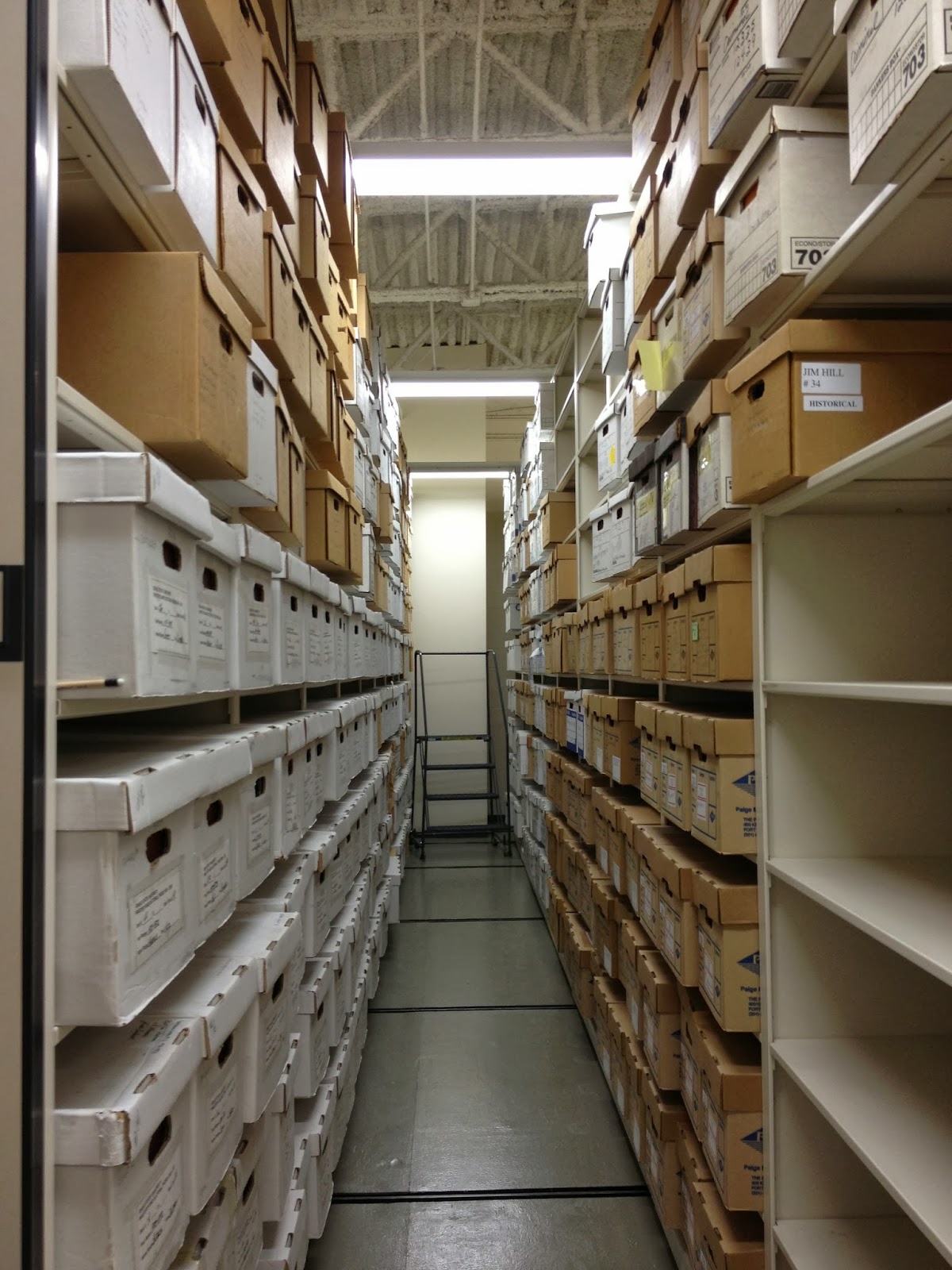
  • On the first afternoon of the conference, I got the chance to tour Idaho's State Archives.  What an amazing collection and terrific resource for anyone researching Idaho history!  We have an impressive selection of personal correspondences, records, publications and photos here at our own Centennial Annex, but the volume of material preserved in the State Archives is truly remarkable.  Their map room alone houses thousands of historic records, which have been utilized by genealogists, scholars, and lawyers, just to name a few of the groups that benefit from the good work of the Idaho State Historical Society.  If you'd like to learn more about the resources available at the State Archives, see http://www.history.idaho.gov/archives-collections

The Archive's research center also happens to be a beautiful and comfortable space to visit and utilize.

Just a tiny fraction of the materials the ISHS preserves and protects

  • Later that evening, conference attendants were invited to an opening session at the Idaho State Historical Museum where we could make new connections.  This also provided us with an opportunity to check out "Essential Idaho - 150 Things that Make the Gem State Unique," an exhibit that commemorates the sesquicentennial of the Idaho Territory.  I absolutely adored this showcase, and I encourage everyone to visit it before it comes down in December.  The exhibit is so wonderfully curated, with installations from across time and place.  Latah County is particularly well represented, with notable mentions of Frank Robinson (Psychiana), Carol Ryrie Brink (Buffalo Coat), agriculture on the Palouse, and Dan O'Brien (UI decathlete). 
    The history of Potlatch is spotlighted in "Essential Idaho"

    Potlatch native and UI graduate Malcolm Renfrew created Teflon

    Latah County plates welcome visitors to the State Historical Museum
  • I enjoyed listening to all of the panel presenters I heard from during the conference, but there was one contributor who really inspired my creativity and imagination.  During the session titled "Get Out of the Classroom," the communications director for the Boise Department of Arts and History and the curator for downtown Boise's Sesqui-shop, Rachel Reichert, discussed the ways in which she and her team have been drawing on an existing enthusiasm for history within the community to develop a dynamic space to tell the story of the city.  I was fascinated by her examples of how the Sesqui-shop has consistently engaged a diverse audience with programs and exhibits.  By moving beyond any "traditional" concept of what a museum should look like, the folks at the Sesqui-shop have both commemorated Boise's first 150 years and fostered new relationships throughout the city, which will no doubt benefit it's next 150 years.  I hope to explore how we here at LCHS might be able to capture some of that same energy to draw in a larger audience through innovative events and programs, and through-provoking exhibits that allow Latah County community members to take ownership of their history.  If you are in downtown Boise, please check out the Sesqui-shop, http://www.boise150.org/sesqui-shop/

Small displays are curated using objects loaned by community members, making the exhibits both personal and relevant

An open concept allows the Sesqui-shop to hold numerous events, performances, and workshops each month

  • Thursday evening's plenary speaker, Dr. Brent Glass, director emeritus of the National Museum of American History, also provided some wonderful food for thought.  As he noted, museums are among the most trusted sources of history for most Americans, and with that comes a significant responsibility to provide visitors with accessible, engaging, and meaningful experiences.  In light of this week's government shutdown, which has forced institutions like the Smithsonian and National Parks to close, the value of our nation's heritage institutions has been on the minds of many.

Dr. Brent Glass
  • Also on Thursday evening, conference attendees were treated to a delicious dinner and delightful entertainment on the Basque Block in downtown Boise.  The Basque population of Boise has a long and rich history, which was shared with us that evening.  While most people might think of archaeological digs taking place in open fields or old battle sites, archaeologists working in the Basque Block continue to make new discoveries and learn more about the history of that neighborhood through excavations in and around the Jacobs Uberuaga House.

The Jacobs Uberuaga House

LCHS Member Barb and LCHS Trustee Lynne enjoying the festivities

Yummo!  Paella at the Basque Center

The venue for our evening's activities

Basque dancers
  • Finally, both the venue of the conference and my traveling companions were of the highest quality.  I had never been to the State Capitol before, and so I enjoyed the opportunity to explore both the building and the grounds.  Two of our Board of Trustee members joined me at the conference, and I know that Harriot Hagedorn and Lynne McCreight are equally as excited to share what they learned with our members and the communities we serve.
Idaho State Capitol building

Idaho State Capitol Senate Chambers
Interior view of State Capitol dome

Myself, Lynne and Harriot enjoying the "Essential Idaho" exhibit!


Wednesday, September 25, 2013

Farmer Fix

Keyhole Saw, LCHS collection

Our volunteer and friend Rod Headrick recently brought us a tool chest with a rich family history.  This large chest was the property of Rod’s grandfather, Reuben H. Headrick, who hauled it over the Oregon Trail first to Oregon in 1870, then brought it to the Lenville District of Latah County in 1876. 

Among the hand tools in the chest is one that particularly catches the eye.  It’s a keyhole saw blade that has been mounted in a handle made from the crotch of a tree limb.  This kind of ingenious “farmer fix” has a special kind of appeal, the result of making do with whatever is available to get a job done.  The blade is attached to its tree limb handle with a combination of hardware: a nail through a washer on the other side where it was cut off and peened, a flathead wood screw that was cut flush, and a twisted-off piece of wire.  According to our LCHS Trustee and carpentry expert Steve Talbott, the wire likely became necessary when the screw split the wood at the fore end of the handle.

This makeshift handle is wonderfully ergonomic and practical.  The “fix” was apparently successful, as the wood of the handle has been polished to a dull sheen with use over time.  Drop by the Centennial Annex and take a look!

Thursday, September 19, 2013

A Curious Collection from Viola, Idaho


A few weeks back I came across a curious collection in our archival storage with a note attached reading “Needs processing.”  The canvas-covered wooden box, stamped with the letters K.O.T.M., had been donated some years back by a friend of the historical society, but had never been fully catalogued.  I was immediately intrigued and decided that it was high-time for us shed some light on this curious group of objects and documents. 


The “K.O.T.M” stood for Knights of the Maccabees, and inside the wooden chest was a nearly complete set of records from the Viola Tent (or chapter) of the group.  I had never heard of this fraternal order, whose records indicated a sophisticated organization with a large and national membership.  So I did some digging.

The Knights of the Maccabees began in Ontario, Canada in 1878 as a fraternal organization primarily concerned with providing insurance benefits to its members.  The original organizers were also members of the Order of the Foresters, and K.O.T.M. was created to care for their fellow laborers.  Specifically, membership in a K.O.T.M. tent provided family’s with money to cover the final expenses of a loved one.  For this reason, men working in professions deemed exceptionally hazardous, such as coal miners and others who worked with highly explosive materials, were barred from joining.  K.O.T.M. reached its zenith in the years before WWI, when it boasted a membership of more than 300,000.
 
The Viola Tent was established in 1898 and appears to have been active into the mid-1910s.  As I processed the archival materials, I was struck by just how much can be learned from the ledgers, correspondences, and official K.O.T.M. publications that had been tucked away for many decades. 

There is a ledger containing the minutes from the Viola tent’s very first meeting.  

 
There is a Roll of Membership that tracks the initiation of new members from 1898 to 1904, which includes the initiate’s occupation and designated recipient of death benefits.  


There is even a catalogue of “Properties,” from which fraternal organizations could purchase important ritual materials.  After perusing the catalogue, I am left wondering just what the initiation was like for a new K.O.T.M. member.  


Along with the hundreds of pages of documents, we received a few very interesting objects.  The wooden chest is eye-catching by itself, and was accompanied by a gavel, black and white marbles used for secret voting, and a seal press.  


There was also a small wooden vessel containing hair.  Its use is unclear at this point, but hopefully further investigation will illuminate the purpose of this strange object.  

 
If you are interested in learning more about the Knights of the Maccabees, you could check out these primary documents available online.


  • Revised laws of the Knights of the Maccabees of the World [microform]: governing the supreme tent, great camps and subordinate tents, adopted May 18, 1895, in force after June 18, 1895 (1895) available http://archive.org/details/cihm_55757
Or you could stop by the Centennial Annex and sit down with our collection.

Friday, September 13, 2013

Barnstorming the Bonfire

The long-standing rivalry between the University of Idaho and Washington State University was punctuated by a unique occurrence on Friday, October 16, 1925. At this time, WSU and UI students practiced a tradition whereby each school would build a large bonfire the night before a Homecoming game, or the night before a game against their arch rivals.

Construction of the bonfire would begin with three poles obtained form the Washington Water Power Company arranged in a tri-pod fashion. Freshmen then filled the open space at the bottom with flammable material. According to Rafe Gibbs from Beckoning the Bold : Story of the Dawning of Idaho, "favorite items for the bonfire were old wooden outhouses. Usually one crowned the collegiate ritual pyre, and was likely to be labeled the administration building of the opposing school". Naturally, it was the ambition of each school to prematurely light the bonfire constructed by their rivals.

University of Idaho Bonfire, "Top of the Pile, 1932" LCHS 17-8-44

On Friday, October 16, 1925, the day before a football game with Washington State University, Idaho students were in the finishing stages of building their bonfire. The bonfire was located in the Fair Grounds (now Ghormley Park). Gibbs writes:
Nearby, a football game was in progress between Moscow and Kellogg high schools, with a large crowd in attendance. The game, however, became a secondary attraction. From the west droned an airplane. It circled over the Fair Grounds, then dived. As it roared over the target of debris, a homemade, phosphorous bomb was dropped. The aim--or timing--was poor. It was so poor, in fact, that the bomb came closer to the football crowd than it did to the bonfire in the making.

The plane repeated its actions twice more. Here we'll let the Daily Star Mirror describe the action:
...each attempt was foiled by removing the cakes [bombs] before they set fire to the pile of wood. Three shots were taken at the plane by Sheriff Charles Summerfield, who happened to be on the grounds. 
The airplane swept down within, what looked like ten feet of the top of the pile to drop its 'bombs'. 
This was a novel thing for the Idaho students, and caused considerable excitement on the campus. During Thursday night freshmen guarded campus against any invasions and Friday were surprised by the 'air attack'. 
According to Gibbs, Sheriff Summerfield shot to frighten, not to hit. After three shots, the plane flew away.

The plane had been chartered by a WSU fraternity in an effort to prematurely light the UI bonfire. The fraternity had put one of the brothers on board as a bombardier. Gibbs writes:
The bombardier claimed that when the plane landed a nick was discovered in the propeller, and 'it looked like a bullet mark.' The pilot, however, said the nick had been there long before Summerfield went into action.
 Sadly, the bonfire tradition was discontinued after 1935. This probably made for a less exciting pep rally.

University of Idaho Bonfire, "The Big Blaze, 1932" LCHS 17-8-44

This story was uncovered when Bruce Kitt contacted LCHS requesting information about an "airplane attack" on the Vandal bonfire before the UI v. WSU football game in 1925. Upon his referral to UI Library Microfilms, Kitt sent the Daily Star Mirror article. Kitt was reseraching the life of barnstormer Nick Mamer. Mamer was a participant in the air attack, possibly the pilot.

Thursday, September 5, 2013

Harvest Time Around Latah County

Latah County's history has been shaped by a few major industries since the 19th century, most notably mining, timber, and agriculture.  The latter, in fact, was the most important force in the lives of southern Latah County residents.  Agriculture, moreover, continues to be a significant part of the county's overall economic base.  As harvest marches forward throughout the Palouse, we are reminded of earlier generations of farmers who devoted themselves to the land and to feeding their neighbors, their fellow Americans, and people around the world.

The soil quality of the Palouse is world renowned.  Southern Latah County encompasses some of the most fertile land on Earth, and it is known as one of the best places in the U.S. to grow wheat, dry peas, and lentils.  Even before the arrival of settlers from farther east, the region was known by the Nez Perce and other local American Indians as a bountiful region for camas and huckleberries.

Today's farmers uphold the traditions of harvest time, including hard work, dedication, and camaraderie with one's neighbors.   

LCHS 25-02-171

Combine pulled by 26 horse team, circa 1900.  LCHS 25-02-100

Like many young men in Latah County, the writer of this note was busy during harvest time helping friends and neighbors.  He writes "I am helping Mr. Roberts thrush now and expect to help others also and am very busy but will write later.  I don't think I will be able to come over Sunday as we are using the horses at present."  LCHS 01-02-076 
A farmer's wife and daughters were busy during harvest time as well.  Preparing meals for a dozen or more hungry men was a tall order in the best of conditions, let alone working out of cook wagon like the one above.  LCHS 25-02-172

At Gold Creek on the George Harris place, about 1915.  LCHS 25-02-169

Fred and Herman Johnson threshing outfit.  LCHS 25-02-101

Idaho National Harvester, 1908 model.  LCHS 25-02-105

C.T. Stough.  Photo by Burns, Pullman, Wn.  8-31-11.  LCHS 25-02-044

Hampton-Driscoll Harvest, 1931.  LCHS 25-02-043
Locals pay homage to the past when they put on an "old fashioned harvest" for spectators, such as this event in September 1998.  LCHS 25-02-468