Thursday, June 27, 2013

Ann Catt's Bench


If you happen to visit McConnell Mansion in the coming months, you can pause and rest on the bench dedicated to retiring Museum Curator, Ann Catt. The bench was donated by the Board of Trustees, it was installed on June 25, 2013. The bench blends in beautifully with its surroundings. It's located to the right of the front porch, directly behind the McConnell Mansion sign.

Thursday, June 20, 2013

Frank Robinson & Psychiana

Frank Robinson, founder of Psychiana
Psychiana workers assembling lessons to be mailed out.


Page from Keith C. Peterson's booklet "Psychiana: the Psychological Religion",
showing an advertisement for Psychiana. 

Cover of Psychiana Lesson 1, that would have been mailed out to  followers.
Lesson 1 has been reprinted in Keith C. Peterson's booklet.

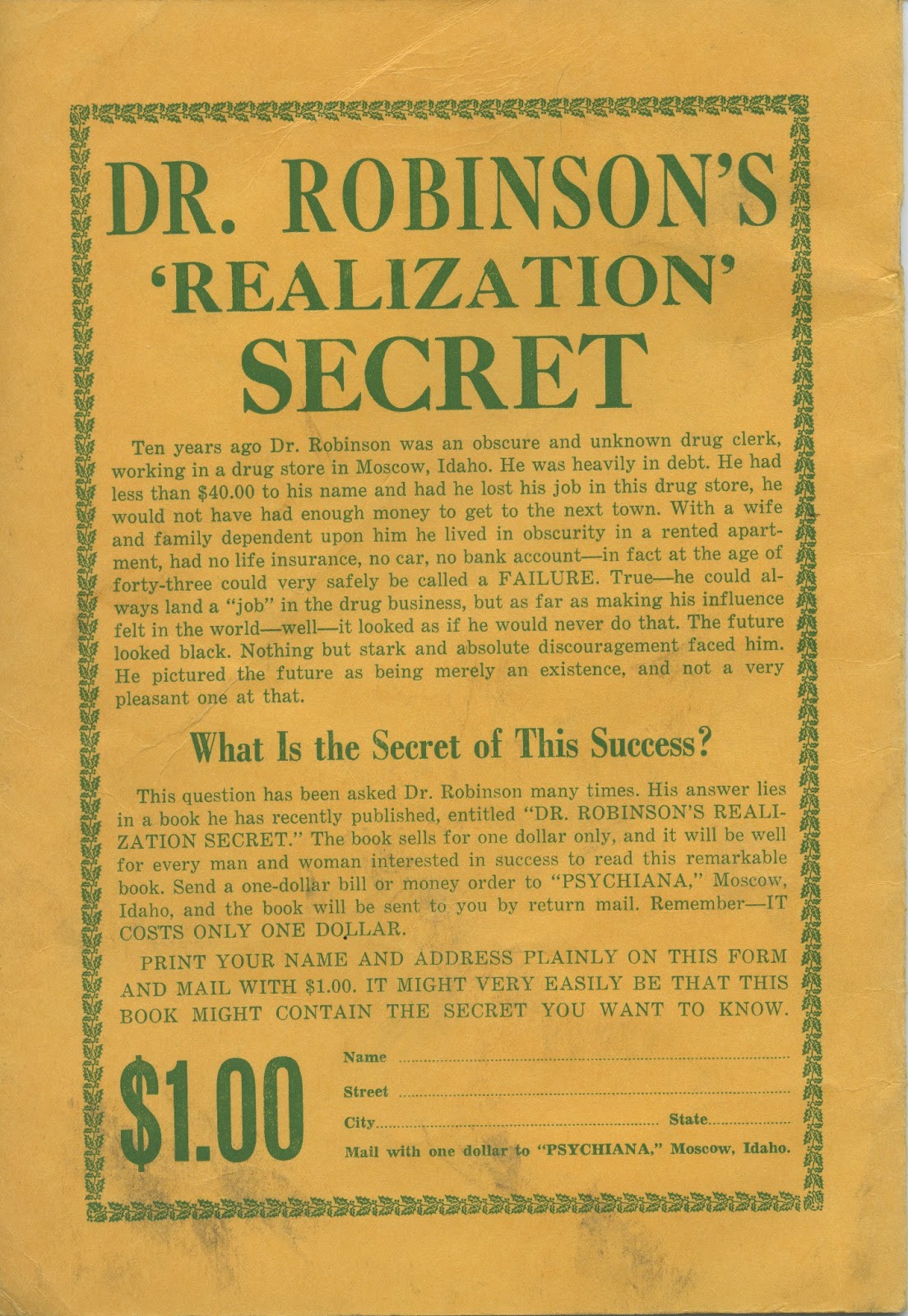
Advertisement on the back of "Psychiana Quarterly", from our Psychiana collection.

“Born in England in the 1880s to a hellfire Congregationalist minister, Frank Bruce Robinson emigrated to Canada when his step-mother forced him from home. Discharged from the Royal Canadian Mounted Police and the United States Navy for alcoholism, Robinson became a druggist in Oregon and Arizona, moving to Moscow, Idaho, in the late 1920’s” (Peterson).

Something happened to Frank Robinson in the interim. The Spirit of God talked to him, and gave him a message. He set out to share this message with the world, through his new religion, Psychiana, which became the world’s largest mail order religion. He operated his business from Moscow, Idaho for two decades, from the 1920’s to the 1940’s. During the height of his success, Robinson employed over a hundred people. He kept them busy assembling and mailing out his lessons, advertisements, brochures and books on Psychiana. 

“…Robinson disbelieved in heaven and hell. His was not ‘pie in the sky’ religion. All desires could be met on earth. People were rewarded or punished on earth for good or bad works. But he did believe in eternal life. The soul—or Life Impulse—could not die.” Psychiana was a self-help religion, rational, and “partially secular and non-Christian”. Adherents could obtain “happiness, health, and financial prosperity” through the God Power (Peterson).

Robinson never promoted his religion locally, he didn’t want his family to be discriminated against. He did use his wealth to benefit the community. He gave to local charities, created the first youth center, and donated the land that became Robinson Park.

The quotes and information in this blog post are from From Psychiana: The Psychological Religion by Keith C. Peterson. The Latah County Historical Society has booklets available if anyone is interested in learning more about Frank Robinson and Psychiana. 

Our Psychiana collection includes documents, advertisements, and other memorabilia, as well as several photos of Frank Robinson and his business. Robinson’s satchel and collar are on loan for an exhibit at the State Museum in Boise for Idaho Territory’s sesquicentennial. You can see a photo of the exhibit in our June 2013 newsletter or go to the Idaho State Historical Society’s website.

Text from the Psychiana Quarterly ad:

Dr. Robinson’s ‘Realization’ Secret
Ten years ago Dr. Robinson was an obscure and unknown drug clerk, working in a drug store in Moscow, Idaho. He was heavily in debt. He had less than $40.00 to his name and had he lost his job in this drug store, he would not have had enough money to get to the next town. With a wife and family dependent upon him he lived in obscurity in a rented apartment, had no life insurance, no car, no bank account—in fact at the age of forty-three could very safely be called a FAILURE. True—he could always land a “job” in the drug business, but as far as making his influence felt in the world—well—it looked as if he would never do that. The future looked black. Nothing but stark and absolute discouragement faced him. He pictured the future as being merely an existence, and not a very pleasant one at that.
What Is the Secret of This Success?
This question has been asked Dr. Robinson many times. His answer lies in a book he has recently published, entitled “DR ROBINSON’S REALIZATON SECRET.” The book sells for one dollar only, and it will be well for every man and woman interested in success to read this remarkable book. Send a one-dollar bill or money order to “PSYCHIANA,” Moscow, Idaho, and the book will be sent to you by return mail. Remember—IT COSTS ONLY ONE DOLLAR.
PRINT YOUR NAME AND ADDRESS PLAINLY ON THIS FORM AND MAIL WITH $1.00. IT MIGHT VERY EASILY BE THAT THIS BOOK MIGHT CONTAIN THE SECRET YOU WANT TO KNOW.


Wednesday, June 5, 2013

Katherine Campbell, MHS Class of 1928

Quilt commemorating Katherine Campbell's graduation from Moscow High  School in 1928.
Kate Campbell Wagner taken in Idaho or Spokane.
(This was most likely taken  after she started her career.)

Katherine Campbell Wagner, circa 1930's.

Joyce Matthys & Katherine Campbell, September 2010.
Katherine "Kay" was 99 years old.
Katherine Campbell was a member of the Moscow High School graduating class of 1928. She grew up on a ranch near Genesee with her parents, George and Minnie Campbell, and her brother, Ray.

The Latah County Historical Society has received a few delightful items commemorating Kay's time at Moscow High School. Among the items are a a quilt top with "MHS--1928" on the center square, probably sewn by Kay's mother. The quilt has initials that are most likely from high school friends. We have also received an initialed handkerchief, a tassel that might be from Kay's graduation cap, as well as the above photos.

Kay worked for her room and board during high school, this prevented her from taking part in any after school activities. However, Kay was an "A" student, and she mentioned being offered a scholarship to Stanford (but her parents wouldn't allow her to to travel so far away from home). After graduation, Kay moved to Spokane and married Roy Wagner.

Kay passed away in December 2012, leaving these items to a family friend, Joyce Matthys. As Kay had no descendants, Joyce sent the items to Moscow High School, and they donated the items to LCHS.

We are most pleased to be able to add these items to our collection. MHS has Kay's yearbook in their collection.

Friday, May 31, 2013

Latah County Poor Farm

Layout of the Latah County Poor Farm, circa 1938.
Circled numbers with arrows indicate vantage point from which accompanying photos were taken.
View of the wood shed, cellar & main building.

From top left: cow barn, shop, granary, chicken house
Before programs like Medicare, the county was responsible for supporting the indigent. Poor Farms were established to take care of the county’s indigents and the elderly. Above are the layout and photos of the Latah County Poor Farm, just north of Moscow.

 The Latah County Poor Farm eventually became the Latah Care Center through the efforts of Grace Wicks and other community members.

Excerpt from the Latah Legacy, Vol. 22, No.1, Spring 1993. “How Latah Care Center Became No. 1”, p 4-5.

“[The Latah County Poor Farm] was located north of Moscow near the site of what is now Radio Station KRPL.

The indigent and the aged who were indigent were housed in the big farmhouse. The farm itself provided an opportunity for those who were able to work doing various jobs to help pay their way and to enhance their self-esteem. […]

Besides the main farmhouse, the complex of buildings included: a woodshed and rooms used sometimes to house patients; a cellar for storage; a hospital; a smoke house; a granary; a machine shed; a blacksmith shop; a chicken house; a pest house (used in earlier years to house paitents with communicable diseases); a hog feed cookinghouse; a cow barn; a horse barn; a hog house; a pump house, and a root cellar. And of course there was an outhouse or two.”

Other sources include “Latah Health Services initially created to replace poor farms”, from the Moscow-Pullman Daily News, July 6 &7, 1996, p1A.


Wednesday, May 22, 2013

Ione Adair and the 1910 Fires

Ione Adair, 1906

Ione Adair Journal, August 3rd through August 4th, 1910

Ione Adair Journal, August 4th continued, 1910


Born Ione Adair, Pinky was ten when her parents left Kansas for the frontier in search of a new life.  They settled in Moscow, Idaho where the community welcomed Dr. Adair and his clan. [The Adairs were the second family to live in McConnell Mansion.] The family took in boarders and enjoyed an active social life, including summers spent on a family homestead where Pinky was one of the first girls to ride “stride saddle.”

 In 1910 Pinky decided to establish a homestead of her own.

This was a daunting course of action, but one Pinky pursued unwaveringly. She taught school to make money both to claim the land and build a cabin. The journey into the timber by stage, train and packhorse (who fell off a snowy trail) getting supplies, staking a claim and building her home presented every imaginable obstacle. But Pinky and her fellow female homesteaders (The Maidens of 49 Meadows) established their own small colony.

But the Big Burn of 1910 had changed it all, for the homesteaders and what would become the New West.

Pinky could be seen through the smoke by her fiery hair and .38 revolver she always strapped to her waist.  As the blaze encroached, she was approached to cook for some of the thousands of recruits enlisted to fight the fire. It was a grueling assignment, but she persisted, making the most of sparse supplies (though later in life she had trouble even looking at a potato). No one in her family knew her fate, and after weeks feared for the worst. By August 20th, the fire was so bad their encampment erupted in anarchy.  Finally, Pinky snatched her blanket and headed for the nearby river with, among others, five dozen prisoners from Missoula. Alone, Pinky crawled out of the river and declared she wouldn’t die in the creek.  They declared HER crazy and she scoffed she had no intention of dying there and would WALK to Avery, some thirty miles away.

--From Annie Fujii, great-niece of Ione Adair.

Following is a transcript of the journal entries pictured above, chronicling two days of Ione Adair's experience as a camp cook during the 1910 fires.


Journal transcript:


Aug.  3.   Wednesday.  How time does fly. We have but little time. we took time to wash and bath our feet this  P.M. Such dirty greasy clothes you never saw in all your life. My eyes are nearly put out. I slept last night for the first time in a week. I could not sleep Tues night because the horses were  right behind our beds and stampeded three or four times trying to get to the trail.
Aug. 4,  All went well till five thirty. Nine extras came in for supper. There was some pretty tall hustling to make a dinner for eight do for nineteen. The cooks waited. Mc Peak brought the packs in also the mail. got a letter from Evon[?] & Cad also a note from Papa. More horses for[?] nightmare only twelve head at our bid last evening.
Aug 5.


Come visit the Centennial Annex for more information on Ione Adair and her family.

Wednesday, May 15, 2013

Charles Houston Shattuck at the Bovill Hotel

Guest Register for the Bovill Hotel 

Charles Houston Shattuck

The 1910 through 1912 guest register for the Bovill Hotel is part of the 22nd accession of 1977, donated by Oren Bigham, as part of a larger collection of guest registers that record the hotel’s guests up through  1956.  These registers reside in the document collection of Latah County Historical Society, housed in our Centennial Annex facility.

It’s delightful, but no surprise, to find the great Charles Houston Shattuck registered at the Bovill Hotel on October 27, 1910.  Founder of the U of I Forestry program, one of the first in the nation, he had convinced officials of the Potlatch Lumber Company to allow him to use their mills and logging camps as teaching and research facilities.  Shattuck ultimately became the first dean of the college of letters and science.  The old arboretum on campus is named in his honor.


Wednesday, May 8, 2013

USO Canteen to Benefit Inland Northwest Honor Flight


On Sunday, May 5th, the Hog Heaven Big Band teamed up with Dudley Loomis Post #6 of the American Legion to put on a USO canteen themed  dance to raise money for Inland Northwest Honor Flight.  Honor Flight recognizes veterans of WWII, taking them to Washington DC to view the new WWII memorial and tour the capital.  Wayne McProud of the Hog Heaven Big Band approached LCHS to see if we could share some WWII materials for the event.  As it happens, LCHS has a remarkable collection of WWII home front posters, and we took about fifty of them to the fairgrounds pavilion for the evening.  With the help of volunteers Rod Hedrick and Helen Almojera, we put on quite a show with the posters.  We’re still hearing nice comments about our role in an important event for a worthy cause.