Friday, August 29, 2014

Join Us for a One-of-a-Kind Tour!

On September 20th you have the opportunity to join Idaho's State Historian Keith Petersen for an exciting and educational day of travel through eastern Washington and north Idaho.  Petersen's most recent book, John Mullan: The Tumultuous Life of a Road Builder, is the first comprehensive biography written about the man who surveyed one of the most important routes in the American West.  In fact, much of Interstate 90 in this part of the country still follows the route designed by Mullan nearly 200 years ago.  The upcoming bus tour will traverse parts of Mullan's road and will make stops at other locations of significance in the early Euro-American settlement of our region.


 So come along and learn about...

ISAAC STEVENS:  Did you know that we have a monument to the first governor of Washington right here in Latah County?  The survey work done by Stevens in the 1850s is integral to John Mullan's story, and we will begin our journey at this little known marker.

 Source: http://hdl.loc.gov/loc.pnp/cwpbh.02650
BATTLE AT STEPTOE: On May 17, 1858 Lieutenant Colonel Edward Steptoe's forces clashed with a group of American Indians from the Palouse, Spokane, and Coeur d'Alene tribes outside of present-day Rosalia Washington.  As Keith Petersen will explain, this escalation in hostilities between whites and American Indians required Mullan to adjust his surveying plans and ultimately affected where the road was constructed.

Source: www.wsdot.wa.gov
 
PLANTE'S FERRY PARK: This Spokane park is located on the spot where French-Canadian trapper Antoine Plante settled and operated the first ferry in the area.  Mullan passed through this exact location because Plante's ferry was the only way to cross the Spokane River in the early 1850s.

Source: www.spokanecounty.org

This is just a sampling of the stops to be made on our one-of-a-kind tour.  Don't miss your opportunity to learn more about the early history of the Washington Territory from an expert.  Lunch, libations, and a good time will be included!

With just three weeks left until our fall bus tour heads out on the road, now is the time to get your tickets!  Call 208.882.1004 or email lchslibrary@latah.id.us with questions or to reserve your spot.  Tickets for LCHS or Whitman County Historical Society are $75, all others are $85.

Thursday, August 21, 2014

Oral History Collection

Oral history transcripts at LCHS.
In the 1970s, thanks in large part to the bicentennial of the United States, many oral histories were recorded.  At the Latah County Historical Society (LCHS) 480 oral histories were recorded, transcribed and are available for research.  When preforming historical research oral histories are unique.  Many historical resources are written down.  The act of writing something down usually implies that the author paused and spent time crafting a well articulated response to a letter or perhaps a carefully thought out diary entry or even an edited book.

Oral histories can also be described as historical interviews.  These interviews are conducted by oral historians to learn about the interviewee’s life through their words.  Oral histories can add a bit of candor to the historical record that might not have been present in the written record.  Interviews conducted in the 1970s were recorded onto cassette tapes and later transcribed.  The LCHS oral history collection has been carefully cataloged and stored since the interviews were recorded and the transcripts were created.


A box of oral history interviews at LCHS.

In the 1980s a part of the LCHS oral history collection was shared with our colleagues at the University of Idaho.  This was done in order to duplicate the holdings so that if there was a disaster at one location there would still be a backup of these important historic records.  Earlier this year the University of Idaho Special Collections Digital Resources department digitized the LCHS oral history collection.  This collection can now be accessed via the web at their website here:  http://digital.lib.uidaho.edu/cdm/landingpage/collection/latah


Storage for 480 oral history transcripts at LCHS.

The University of Idaho did a remarkable job of making this collection more accessible for researchers as the transcripts are now searchable and the audio is also available.  This is a fantastic resource for researchers, who can now search through transcripts and hear historic figures.

While not all of the LCHS oral histories are digitized on the UI website, many of them are.  I encourage everyone interested in local history to take a moment and search for your favorite Latah County historical figure, event or place in the search function to find out more about the history of Latah County.


 - Zachary Wnek
Museum Curator
Latah County Historical Society

Thursday, August 14, 2014

How to Analyze a Historic Photo in 5 Steps


Today I would like to introduce Luke Sprague to our audience.  Luke Sprague operates HistoryMint.com, a private historical research firm specializing in military history.  Luke Sprague donates time each week to the Latah County Historical Society to assist in reference requests and acquisition appraisals.  This is one such acquisition appraisal which Luke Sprague took the reigns on to determine if LCHS should acquire this photograph.

When a member of the community brings in any type of object into the Latah County Historical Society, there is an investigation to determine how that object fits into the collection. Without the right information, those deciding which objects to add to the collection would face an insurmountable task. Therefore, it is crucial to understand the facts, the history, and historical opinions surrounding each object in order to access its historical value to the collection. In this post, we are going to follow the investigation into a photograph donated by a community member. Here are the five steps I use to research an object—often moving back and forth between the steps.


This is the image donated by a community member.

Step 1: Ask questions


This may seem like an obvious thing to do, but not everyone does it. When a member of community walks in, ask them what is this thing? Where did you find it? Who found it? When did you discover it? What would you like done with it? What research have you already completed on the object and may we have a copy of it? Often, this series of questions reveals important details that help with later research. In this example, by following up with a phone call, I determined that this framed photograph had been found in a garage wall during a remodel. The community member told me he was not related to anyone in the photograph, nor did he know much beyond what he had told me already.

Step 2: Focus your analysis


Key to success in any research is clearly defining the question you are asking. Write down or at least know in your head what question you are trying to answer prior to starting any historical research. Focusing on the question you are trying to answer will determine the speed with that you arrive at the answer. I use the “five Ws” to zoom in on a particular topic: who, what, when, where, and why. In this First World War photograph example the question we are trying to answer is, “Do the men in this picture have any particular relationship with Latah County? Or does the image offer a compelling historic narrative that will improve the Latah County Historical Society collection?” Please note, this does not mean you cannot change your question or revise it, but this technique will tend to focus your efforts and prevent drifting into irrelevant topics.

Step 3: Examine the object carefully


Carefully look at the object and see what details it exhibits. In the case of the above photograph, a closer look provides a wealth of information that makes clear its origin. Look at the below close-up photograph and look at the men’s boots in the front row, notice how they are the same except for one?


 If you look carefully at the center of the photograph with a magnifying glass, you will find a man sitting down in the center of the first row with black boots, he has bright-gold acorns on his hatband, and no one else has them; this is likely their commanding officer.

 
As a standard practice, the commanding and/or senior non-commissioned officer would sit in the center of a photo such as this. The officer also wears rank insignia on his shoulders and the “U.S.” brass on his collar, whereas the enlisted soldiers wear circular brass “U.S.” emblems on their collars.


 The branch insignia on this officer is compelling evidence. The branch insignia designates what a particular officer specializes in, and in this case, you can just make out the aviation propeller supported by two wings.

 
The branch insignia of the officer combined with where he is sitting indicates that this is some type of aviation unit.


Next, note the text in the lower left, “Section H, A.S.M.S. Kelly Field, Tex 12-7-18.” This text alone reveals the photographer likely took the photo at Kelly Field, Texas on December 7, 1918 with men wearing First World War United States Army uniforms. For now, set aside the text “Section H, A.S.M.S.,” we will come back to that later.


The lower right corner of the photograph shows that this is a “Photo by Stead,” likely an Army photographer or as it turns out in this case, a photographer under contract to the Army.


Color enhanced image of the back of photograph
The back of the photograph shows that, “From Chas A. Stead [illegible] Kampann BLDG San Antonio, Texas, Phone Travis 2028” likely took this photograph.

 
Also on the back of the photo are a negative number, date, price, and significantly, what appears to be someone’s surname, “Zinsser.” There is also something written underneath “Zinsser” but it is not clear what it is, looks like “Cui…mnd.”

Step 4: Use research to learn more about the object

After examining the object itself, it is time to use research to discover more about the object. Research on each object often is exhaustive in nature to where you reach a point of diminishing returns, limited by budget and available labor. The depth of historical research can potentially be unlimited; however, at some subjective point, you (as the researcher) will know that you have found as much detail as is relevant. In my opinion, the researcher is looking to “paint a picture” of the past that often is only 75 to 85 percent accurate and beyond this return on effort can drop off significantly. This is the art of historical research, finding that “sweet spot,” where a somewhat accurate image of the past is created at a reasonable cost.

I recommend less experienced researchers start with a structured search plan that leads your research through specific search tools and known resources. After more experience, I think you will find that you will develop a sixth sense or instinct about where specific objects and details can be found. This “gut” instinct can be extremely valuable as it grows over time—listen to it! Organization is fundamental to successful historical research; I strongly suggest a note taking system, a filing system, and a formal documentation system.

Specifically for this photograph, with a little bit of research we learn that the Army used Kelly Field Texas as a new Aero Squadron training facility for the First World War. In the First World War, Aero Squadrons were still part of the Army Signal Corps and had just begun to make the transition to a separate branch within the Army. The Signal Corps linkage harkened back to the Army using balloons for reconnaissance, observation, and signaling. Between 1917 and 1918, the Army trained thousands of pilots, mechanics, and support personnel at Kelly Field, Texas. Of particular interest to us, are the Mechanical Service (M.S.) Squadrons that trained mechanics for wartime aircraft. These “school house” units turned out thousands of students each month during the First World War.


This is why in the photograph above you see the “A.S.M.S.,” an acronym for Aero Squadron Mechanical Service. The “Section H” stands for the new unit identifier created for the unit in July 1918 replacing from the former unit identity, the 244th (II) Aero Squadron. It is unclear why the photographer labelled this photo “Section H,” though it is in all likelihood a mislabeling of “Squadron H,” given that a United States Army section is much smaller (7 to 9 soldiers) than a squadron (usually hundreds of soldiers). In addition, the United States Army does not designate smaller size units, like sections, with letters, but instead uses numbers.

Interestingly, this was also likely the demobilization photograph for this unit as the First World War ended and the majority of soldiers returned home. This newly designated Squadron “H” at Kelly Field Texas of the Aero Squadron Mechanical Service remained in active service from July 1918 to November 1918 with our photograph dated December 7, 1918. Squadron “H” at Kelly Field Texas never deployed to Europe but instead served as a training unit stateside.


Concerning the surname “Zinsser” on the back of the photograph, I had optimism that this would link us back to Latah County, Idaho. In terms of general research techniques, I recommend starting the name search with known and reliable indexes, and then moving on to related organizations. With this photo, the card catalogue revealed a small number of Zinsers in Latah County Idaho, but no Zinssers with two “s.” The Past Perfect database indexing the collection closely mirrored what I found in the card catalogue.

We also at one point had hopes that the Zinsser name on the photograph might be an ancestor of Elizabeth Zinser, the former first woman President of the University of Idaho, but unfortunately, her ancestors were from Pennsylvania not Idaho. The birth and death indexes for Latah County Idaho revealed for all practical purposes no Zinssers with either one or two “s” in a lifespan. The obituary files showed no Zinser or Zinsser that would have matched a soldier in the 1918 photograph.
The Latah County Historical Society photo collection also showed no connections or linkages to this image. All third-party online databases including the First World War draft records for Idaho and Fold3HistoryMint.com show nothing for a various spellings of Zinsser in Latah or surrounding counties. Also problematic, the address the community member provided made no sense in terms of their explanation of the discovery; therefore, a property deed search based on the street address made no sense.

Step 5: Explain your findings

This step is self-explanatory; explain to your client or in this case Latah County Historical Society what you have found. Often you will find nothing or not what you expect, and though it may not seem like it, this is a result.

For today’s example, I find that at this time the “Zinsser” First World War photograph has no linkages to Moscow or Latah County. This is a photograph from an Army training or “school house” unit at Kelly Field Texas. This unit, Squadron “H” existed for five months from July 1918 to December 1918 and likely cycled through numerous trainees during that time. Thousands of American men attended these types of training units during the First World War and the majority of the units took photographs like this one.

Soldiers who paid for this photograph may have taken it with them as they moved throughout the country during their lifetimes. The discovery of the photo in Moscow does not imply a strong connection to Moscow or Latah County, Idaho. Therefore, I conclude that other than an example of First World War uniforms, this object retains limited value to the Latah County Historical Society.

References:

Center of Military History. Order of Battle of the United States Land Forces in the World War, Zone of the Interior: Directory of Troops. Vol. 3, part 3. Washington: Center of Military History, United States Army, 1988.
Latah County Historical Society, Moscow, Idaho (hereafter LCHS) all photograph credits.
LCHS, Archives, Small Collections 92-62.
LCHS, Archives, Small Collections 02-40.
LCHS, Latah County Birth and Death Indexes.
LCHS, Obituary Files, “Z.”
LCHS, Photographs, Latah County 30-16.
LCHS, Photographs, Moscow 1-7-16.
LCHS, Photographs, Moscow 1-11-16.
“United States World War I Draft Registration Cards, 1917–1918.” Index and images. FamilySearch.org: accessed 2014. Citing NARA microfilm M1509. Washington: National Archives and Records Administration, n.d.

Author:

Luke Sprague, M.A., lives in Moscow, Idaho and helps authors, screenwriters, and other creators with their United States military content for HistoryMint.com. Luke is also a volunteer researcher at the Latah County Historical Society in Moscow, Idaho.

Thursday, July 31, 2014

2014 Ice Cream Social

What a great day for some Ice Cream!  For those of you who didn’t attend, the 2014 Ice Cream Social was on Sunday, July 27th.  The event was a rousing success, and I would like to take a few moments to share with you my impressions of the event.  There were events happening on three sides of the McConnell Mansion and even more fun inside.

The flag was raised at 1:00pm sharp by Gary Grove and his grandson Bryson while local musician Arden Skoglund performed "The Star Spangled Banner" and the Hog Heaven Muzzleloaders sounded a black powder salute.  After the national anthem the Muzzleloaders setup on the west side of Adams Street to inform people about their historical displays, providing a living history experience at the event.  In front of the Centennial Annex, Steve Talbott was splitting shakes out of ceadar.  The shakes were being traded for donations to LCHS, 1 for $1 or 4 for $5.  What a deal!

The Muzzleloaders signaling the beginning of the Ice Cream Social.

On the front lawn of the McConnell Mansion were the children’s events.  Many children enjoyed washing the laundry with wash tubs and ringers, while some of the other children played dress up.  Kids had fun making and designing par fleches, Native American style bags.  Other children made re-usable bags out of old T-Shirts and a little ingenuity, courtesy of the Latah County Sanitation and Recycling Department. 
 
Dress-up clothes are prior to the event.

The Moscow Weavers were situated on the front porch showing off their weaving skills to the public.  Moving into the McConnell Mansion, guests were greeted by volunteers and staff of the Latah County Historical Society who shared with them the history of the home.  Inside of the Mansion was a busy place indeed.  The Appolosa Lace Guild was in the front parlor demonstrating lace making.  In the family parlor there were two exhibits, one was a veteran’s exhibit created by former LCHS Executive Director and longtime supporter, Mary Reed.

The veterans and flag exhibits at the Ice Cream Social.
The veteran's exhibit examined some of the veterans of Latah County from the Grand Army of the Republic up until Operation Iraqi Freedom in 2008.  The other exhibit was a flag exhibit created by current LCHS Executive Director, Dulce Kersting.  This exhibit was highlighted by a hand made flag presented to a Latah County veteran of WWII who helped to liberate parts of Austria at the end of Nazi occupation.  The dining room, hallway and servants quarters were also available to tour on the lower level. 

A member of the Moscow Weavers at the Ice Cream Social.

On the upper floor there was an art exhibit by local artist Kristin Carlson Becker located in the children’s room.  This exhibit was created for ArtWalk and will be available until September 4th, 2014 when the exhibit closes with a presentation by Kristin Carlson Becker on her work.  This event is free and open to the public and we look forward to seeing you all there.  The second major exhibit available for viewing was the Caddie Woodlawn exhibit located in the green room.  The Caddie Woodlawn exhibit showcased the impact of Caddie Woodlawn and the success of Carol Ryrie Brink.

The Caddie Woodlawn exhibit in the Green Room of the Mansion at the Ice Cream Social.
This exhibit contains documents, photographs, video and objects regarding Caddie Woodlawn and was created specifically to open for the Ice Cream Social by yours truly, Museum Curator, Zachary Wnek.  Throughout the house many historic quilts were also on display.  These quilts were created by Latah County quilters.  LCHS has many quilts in their collection and works to alternate the quilts on display. 

Along the side of the house was the band, Undiscovered Country, entertaining the guests all afternoon long with great music.  I would also like to take the opportunity to thank the University of Idaho for the use of their sound equipment.

Undiscovered Country playing at the Ice Cream Social.

Folks enjoying Undiscovered Country.

Also along Second Street was a fire engine and an ambulance courtesy of the Moscow Volunteer Fire Department.  The MVFD had their equipment out and ready to show the public as well as their Dalmation.  There was also a brief history of the MVFD available with historic images and text.  Thank you to the MVFD for their time on Sunday.


The MVFD display board with the engine in the background.

An MVFD Fire Engine at the Ice Cream Social.

At the corner of Van Buren St. and First Street, the northeast edge of the original McConnell lot, guests could enjoy wagon rides up to East City Park, pulled by draft mules.  We would like to thank Anna Boyd for sharing her team with us on Sunday afternoon. 

Wagon rides at the Ice Cream Social!

In the rear of the house was the main event, ice cream with toppings and watermelon.  The ice cream this year was generously sponsored by the Dewitt, Johnson and Lindsey families in memory of their mother Connie Dewitt.  The ice cream was served with your choice of pineapple, strawberries and chocolate syrup.  To augment the ice cream was a serving of watermelon.  There were 660 bowls of ice cream served up this year. 

This annual event was also generously supported by the Latah County Community Foundation.  We thank the Foundation for their commitment to improving the lives of local residents by funding a wide variety of projects, including our community-building Ice Cream Social.  You can find out more about this terrific group, as well as how to donate to their efforts, at www.latahfoundation.org.   

I would like to take a moment to thank everyone involved in making the 2014 ice cream social a great success.  I am sure that I did not mention everybody who helped make this great event possible.  With the 2014 Ice Cream Social behind us, we at LCHS are looking forward to next year already!


Serving up free ice cream and toppings at the Ice Cream Social.


 - Zachary Wnek
Museum Curator
Latah County Historical Society

Thursday, July 17, 2014

Celebrating Local Treasures

This Saturday LCHS is hosting a reception for two of Latah County's finest local historians. Dorothy Anderson and Herman Ronnenberg, both of Troy, were recently recognized by the Idaho State Historical Society for their years of dedication to preserving and promoting local and regional history.  Dorthy and Herman received the state's Esto Perpetua Award in June at a ceremony in Boise, but we wanted to show our appreciation for their tremendous work with a party a little closer to home. 


Please join us on Saturday, July 19th at Troy's Filling Station from 2:00 to 4:00 to congratulate Dorothy and Herman in person.  Refreshments will be available for purchase and a celebratory cake will make this one sweet afternoon!


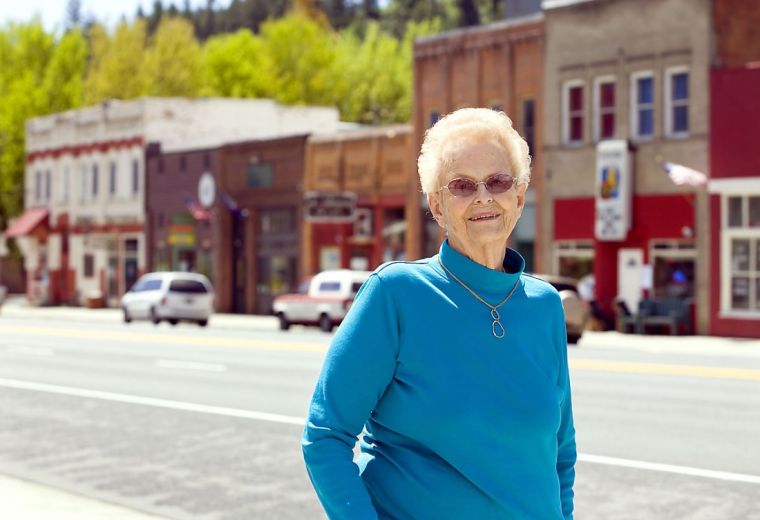
Given this weekend's festivities, I thought I would share with you all the brief biography I submitted with Dorothy's nomination to the Esto Perpetua selection committee.  Dorothy is a truly remarkable woman, and I enjoyed the opportunity to tell the folks at ISHS why she is so great!


            "I first met Dorothy Anderson just three days into my tenure as Museum Curator at Latah County Historical Society.  It was an unseasonably hot June afternoon, and Earl Bennett’s Bovill Run was making a final stop on the north county historical bus tour in downtown Troy.  We were greeted by Dorothy’s friendly face, protected by a broad sunbonnet, and her infectious enthusiasm for her community’s history.  As we began our walking tour of Troy’s commercial district, Dorothy’s insightful and entertaining narrative chronicled the development of the town and helped me forget about the oppressive heat. 
  
            "Just a few weeks later I had the good fortune of making Dorothy’s acquaintance more formally when she visited our archives in Moscow to do research.  I learned that Dorothy moved to Troy in 1944 as a high school student when her parents bought the local newspaper.  In subsequent conversations Dorothy recounted feeling a little sad about leaving her friends in Wyoming to move to the rather remote north Idaho town; those feelings, however, soon passed.  Dorothy has been a resident and booster of Troy ever since.  After marrying her husband Ellis, a native son of Troy, Dorothy attended the University of Idaho to become a teacher.  She spent 26 years with the Troy School District, and it was in this capacity that Dorothy began her campaign to preserve Troy’s history.  

            "It all began, she said, when she and few colleagues in the elementary school realized the need for a local public library.  As a committee formed in the early-1990s to raise money for a new library space, Dorothy and her husband were also quite active in the formation of a group that would plan Troy’s centennial celebration.  Of course many of the people interested in creating a space for community members to share knowledge were the same individuals who wanted to preserve Troy’s history.  Before long Dorothy found herself the leader of a fledgling Troy Historical Society, a role she has been dedicated to for nearly two decades.   

            "Dorothy’s list of contributions to the preservation of Troy’s cultural heritage is impressive.  She served on the Centennial Committee, celebrated in 1992, and no doubt sparked a passion for history in many young Troy residents when she involved her students in collecting oral history accounts from local business owners.  From the gathered information, Dorothy pieced together the history of many of the buildings that make Troy’s downtown such a beautiful example of a 19th-century western town.  In turn, these building histories were used to nominate several structures to the National Register of Historic Places.  As is the case in many communities, some property owners pushed back against the idea, believing that designation would infringe upon their rights.  It was Dorothy who bridged the gap between the preservationists and the owners.  Her personal touch, reinforced by her credibility as a long-time resident, went a long way to allay apprehensions among business owners.  With the hard-won blessing of the owners, many of the nominations went on to be successfully accepted to the National Register.  You can guess who worked on the attractive signage that now adorns each historic building.

            "Another of Dorothy’s accomplishments was organizing the 1995 All School Get-Together, a reunion for all past attendees of schools in Troy and the immediately outlying areas.  She recounted to me that the motivation behind such an all-encompassing event was to provide a reunion for all the men and women who did not get to attend high school, instead going to work after the 8th grade.  Inclusivity characterizes much of Dorothy’s work.  When she took on the important task of documenting experiences of locals who attended the now vanished rural schools around Troy, she again turned to her students.  Not only did she collect incredibly valuable primary accounts of one-room schoolhouse life, she also engaged the next generation of residents in their local heritage.  Moreover, she and her husband Ellis went on to create a 1/12th scale replica of the county school at Burnt Ridge, based on those collected oral histories, that has been enjoyed by residents of Troy and the county as a whole.  

            "Under the expert guidance of Dorothy, the Troy Historical Society has produced a number of invaluable resources.  “Troy, Idaho: A Historical Walking Tour” provides visitors and residents alike with all the information necessary to appreciate the historic structures of the town.  The pamphlet is second only to a guided tour by Dorothy herself, a proclamation I can make based on personal experience.  Indeed Dorothy makes herself available for any school class, historical commission, church group, or scout troupe that inquires.  Members of the Idaho State Historical Society Board of Trustees might remember meeting Dorothy on one such tour a few years ago, when they lunched in Troy at Herman Ronnenberg’s home.  Dorothy also edited and narrated a wonderful video released by the Troy Historical Society entitled Yesterday, Vol. 1, which provides audiences with an overview of the town’s rich history.  Additionally, every year the society produces an exhibit for Troy Old Timers’ Day.  That is, in fact, the occasion that brought Dorothy into my office last summer.  The 2013 exhibit, which consisted of informational posters displayed throughout downtown Troy, related the history of many local businesses.  While the Troy Historical Society has done a terrific job preserving photos and documents on their own, the organization continues to collaborate with other heritage groups like our county historical society to improve their programming and enrich our shared knowledge.  I was happy to contribute some of our original photographs to her exhibit, as any partnership between our organizations surely benefits all of us.

            "The good work of the Troy Historical Society is especially noteworthy because the group has achieved so much with limited resources.  Although the group lacks a traditional museum space and does not own any storage facility of its own, Dorothy and her colleagues have made a significant commitment to preserving local history.  Admirably, Dorothy has sought out the advice of local and state resources.  Keith Peterson of ISHS and Mary Reed of the Idaho Association of Museums have both been invited by Dorothy to consult on future plans for the organization, and Latah County Historical Society has been approached for technical support as well.  Dorothy’s relationship with a prominent family in the community, the Brockes, helped the Troy Historical Society secure a safe space for the storage of archival materials at a local bank.  While a member’s basement might have proven a more convenient location, Dorothy pursued a solution that would protect the resources from potential dangers such as flooding or fire.  An ultimately unsuccessful bid to purchase or lease part of the original Troy High School building for the Historical Society has not deterred Dorothy for identifying venues in which to tell the community’s unique story.     

            "As a relative newcomer to north Idaho, I have a lot to learn about the history of this wonderful region.  Thank goodness for people like Dorothy, who happily answer my questions, no matter how naive.  Her patience and willingness to explain events or describe people seems endless, and truly, I could listen to her wonderful stories for hours.  She has further demonstrated her commitment to educating others by agreeing to serve as Troy’s official City Historian, a program that the Latah County Historical Society supports.

            "Dorothy tells me that even as a child, she knew the importance of history.  An interest in how other people built their lives motivates her projects and an appreciation for other cultures, past and present, continues to inspire her curiosity.  Given Dorothy’s long list of accomplishments, it is clear that she is a lover of history and just as importantly, a lover of Troy."