Tuesday, November 25, 2014

Northwest History Network

This year Latah County Historical Society has been a recipient of a Northwest History Network Microfunding Grant.  This article is written to inform our membership and the Northwest History Network of the progress we have made with the new archival boxes provided by this grant.

In January of 2014 I joined the Latah County Historical Society (Latah County, Idaho with our office and historic house located in Moscow) in capacity as museum curator.  As many of you are aware, work at local historical societies requires working in a variety of roles, some of my daily responsibilities include: curating historical artifacts, registering artifacts, documents and photographs into our collection, organizing volunteers to assist with the operations of the historical society and maintaining and storing archival documents.

The Latah County Historical Society (LCHS) is fortunate to have fully functional rolling shelving for our archives.  This shelving is approximately 70% full of records, each housed in acid-free, archival boxes.  While I was beginning to work with the archival collection I found that many of the Large Collections were a series of smaller boxes, which were labeled numerically since there were no large archival boxes (e.g. LC [Large Collection] Greeting Cards Box 1, LC Greeting Cards Box 2 . . . ).  While this was a bit cumbersome it did not warrant buying new boxes since there were other more pressing needs.  As time rolled on more large collections were donated to LCHS.  As these projects piled up I knew that I had a problem brewing on my hands.

In March I found the Northwest History Network’s Microfunding Grant opportunity.  I applied in an attempt to fix the archival box shortage.  In June I found out that LCHS was funded through the Northwest History Network.  In July I researched archival box options and ended up ordering 30 boxes from Hollinger Metal Edge model number RSB-18 with dimensions 12W x 15L x 10H.  I chose these boxes because of their value for money.  I did a lot of research and calling in order to maximize the Northwest History Network Microfunding Grant.

Since the boxes arrived in August they have been put to work.  Some of the new projects include getting backlogged document collections in acid-free storage complete with new inventories.  At the Latah County Historical Society one of our most prominently researched figures is Frank B. Robinson.  While the Frank B. Robinson Collection is well used there are boxes of unprocessed records in our backlog.  Thanks to this grant LCHS has the archival boxes necessary to begin processing these boxes and make them available to researchers.

The newly completed Robinson collection from the LCHS backlog now processed in acid-free boxes.


Another notable project has been the consolidation of smaller collections.  These boxes have allowed me to combine large collections housed in multiple small boxes into one large box.  This consolidation is not only easier to handle but also allows for quicker and more efficient access by the researchers. 

LC 1912 Center used to be in the three smaller boxes on the left, now it is in the larger box on the right.
The archival boxes have also been used to house new collections.  Recently LCHS received a new large collection of Frank A. David (a prominent citizen who worked and owned department stores in downtown Moscow, ID) papers.  These papers span his and his family’s history in Latah County.  While this collection has not been processed yet, I am able to store them in acid free storage in the meantime.

These boxes have been used not only in the documents collection but also in the textile collection.  LCHS has used these boxes to re-house some of the hats in the collection.  This has moved these hats out of acidic boxes and into acid free long-term storage.

The Northwest History Network Microfunding Grant has been a great way for the Latah County Historical Society to improve its storage while increasing access to our records.  This grant allowed LCHS to maintain archival storage standards while processing existing and new collections.  I would like to thank the Northwest History Network for funding this Microfunding Grant and I hope success at the LCHS will encourage other historical societies to apply to this worthwhile opportunity in the future.

Zachary Wnek
Museum Curator
Latah County Historical Society

Friday, November 14, 2014

Harvest Dinner 2014

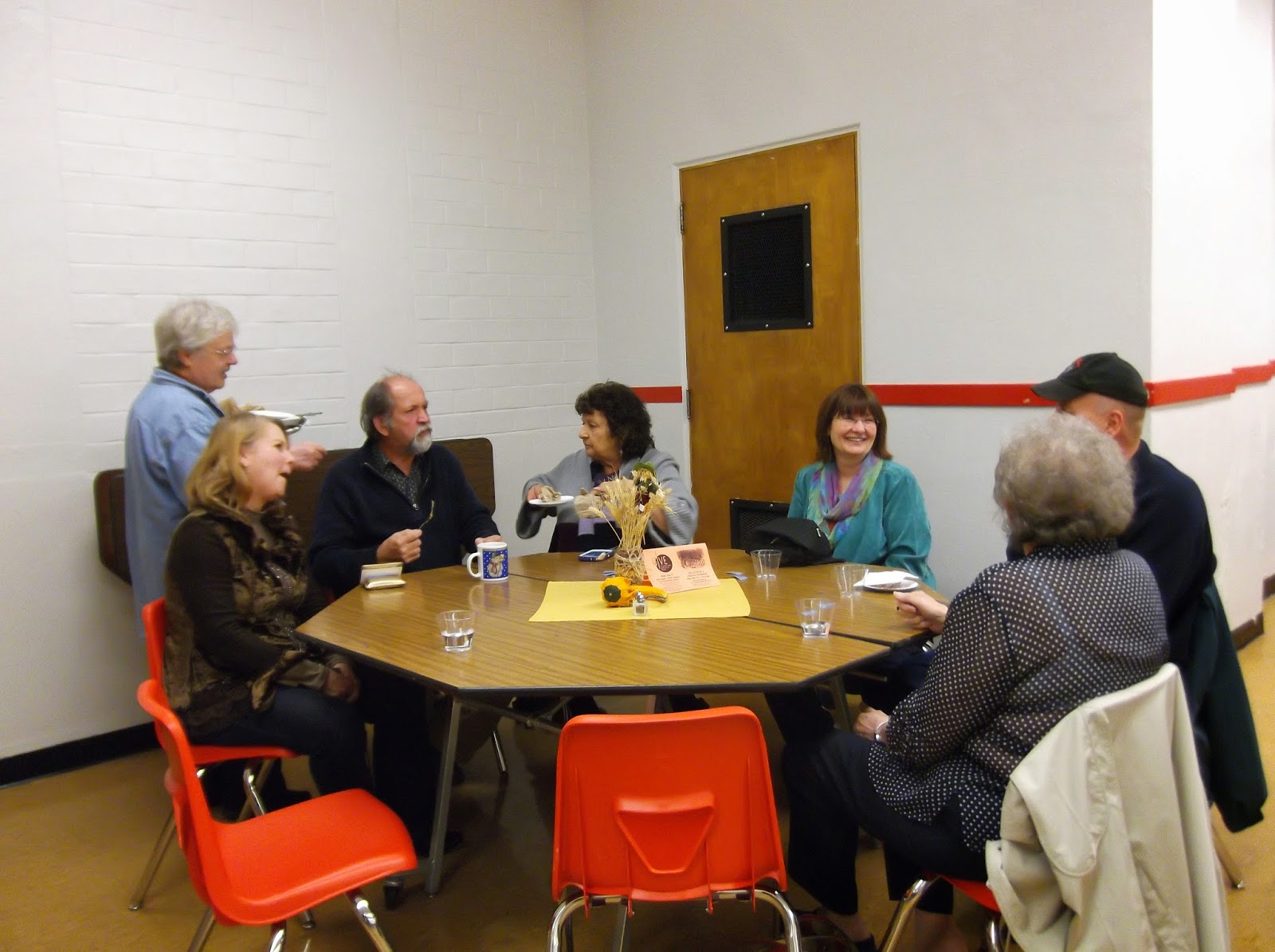
It's that time of year again for the Latah County Historical Society Harvest Dinner!  This year our Harvest Dinner broke from tradition and was offered in a new location, the Moscow High School.  The Harvest Dinner was a great success, thanks to our many volunteers who worked very hard to make it happen.  A special thanks goes out to our great events committee who organized the event.  Below are some photographs from the event.  We look forward to another great event next year!


Thursday, November 6, 2014

Voting in Latah County

Looking back on the most recent election makes us proud here at LCHS.  We believe in the importance of voting and its impact on our lives.  Here in Latah County there has been a long standing tradition of voting and its importance.  In researching our archives we came across the following photos of the voting process.

Joan Bauer, then-Latah County Clerk explains to Moscow High School United States government class voting procedures. Watching are seniors Shelly Bobeck, Chris Tylutki, and Phil Nordquist. No date. 001-6-441.

Zoe Cooley, Moscow Library Board Member, recounting ballots in 1990. Cooley.Z.02.
 While the voting process is important, there is not much about voting that is more important than the actual ballot.  These ballots were from the election held August 14, 1956.  The ballots represent the Republican and Democratic party tickets for that election.  Notice on the Democratic Party Ticket is long time Senator Frank Church.


Lastly here at LCHS we would like to thank everyone who voted in the last election on Tuesday.  Thank you for having your voice heard.  The election results are available from the Latah County Website here.

Monday, October 27, 2014

Make A Difference Day

On Saturday morning the University of Idaho Center for Volunteerism and Social Action sponsored the Make A Difference Day.  Saturday nine UI student volunteers descended upon the McConnell Mansion to help LCHS on some special projects.

The hard working UI student volunteers at the McConnell Mansion.

These students and I worked hard on two projects, one of which would not have been possible without the help of Ryan from Guardian Comprehensive Home Services.  This project was the outside clean-up of the McConnell Mansion.  As you might have noticed it is getting colder outside and the leaves are turning from green to yellow, then onto our lawns.  Ryan from Guardian stepped up and was at the McConnell Mansion early Saturday morning to do some pruning around the grounds before the student volunteers arrived.  Once the volunteers arrived they were set to work raking leaves and prunings, then flipping them into the Guardian truck for removal.

Raking in front of the McConnell Mansion.
Guardian's yard debris removal truck.

UI students flipping the yard debris into the Guardian yard debris removal truck.
A big thank you goes out to Guardian as well as the UI students for helping the McConnell Mansion look its best this fall season!

But wait, there's more!  Here at LCHS we like to host events, however sometimes people need a little extra help finding our event locations.  Years ago wooden folding sandwich boards were donated to LCHS so that we can help people find our events.  These sandwich boards have been well loved over the years and were in need of some re-finishing.  A second group of students worked to pull all of the staples out of the boards, sand the boards and give them a fresh coat of paint.  These students were so efficient that they even helped to rake leaves after they had finished working on the signage!

Sanding and pulling staples from the signs.

Look for these newly painted signs next time you're looking for an LCHS event!
This was a great morning for LCHS as we got more done before noon than I had hoped for.  Thank you to Guardian and to the University of Idaho Center for Volunteerism and Social Action for helping make this event a success.

 - Zach Wnek
Museum Curator
Latah County Historical Society


Friday, October 24, 2014

Volunteer Lunch

Here at the Latah County Historical Society we are serious about our volunteers.  On Thursday 10/23 LCHS hosted some of our volunteers for chili with fixins, vegetables, brownies and cheesecake at the historic McConnell Mansion.  This lunch was a great way for us to recognize our volunteers.  This was also a great opportunity for the volunteers to meet each other.  The lunch was well attended by approximately 20 LCHS volunteers.  Here at LCHS we would like to sincerely thank all of our volunteers for their hard work, without your efforts LCHS would not be what it is toady.

Below are some photos of some of the wonderful LCHS volunteers.


Thursday, October 16, 2014

Archives Month!

October, as some of you may know, is American Archives Month.  To get you in the archival mood, I thought I would begin Archives Month by discussing the Latah County Historical Society archives.  When I talk about archives, I am speaking about documentary history.  Historic papers (also referred to as records) stored in acid free folders and in acid free boxes so that they can be preserved as long as possible. 

The LCHS archival shelving units.  These units hold thousands of records across hundreds of collections.
The LCHS archives are housed in our Centennial Annex.  The LCHS archives consist of five Spacesaver double sided rolling shelving units and one wall mounted shelf.  These 11 shelves contain many treasures of Latah County.  I am hoping to portray these treasures to you with some regularity this month as we celebrate Archives Month.
The records are safely stored in acid free boxes so that they can be preserved for as long as possible.

Below are a few photos of the LCHS archives and the archival boxes used to preserve the records within.  Stay tuned for more as LCHS shares our archives with you, our captivated digital audience, over the course of October.

Collections come in all shapes and sizes with boxes to match.


 - Zach Wnek
Museum Curator
Latah County Historical Society

Tuesday, October 14, 2014

Bus Tour with Historian Keith Petersen


Latah County Historical Society bus tour group September 20, 2014
The Latah County Historical Society bus tour group gathered on the grass just west of Good Samaritan Village, in Moscow, Idaho on September 20, 2014. Photo credit: Earl Bennett

On September 20, 2014, Idaho State Historian Keith C. Petersen led a Latah County Historical Society group on a guided tour of parts of the Mullan Road. May 6, 2014 Petersen released his new book, John Mullan: The Tumultuous Life of a Western Road Builder. His book chronicles the life of John Mullan, a man well known in the Pacific Northwest for his role as architect and builder of the military road between Fort Walla Walla, Washington and Fort Benton, Montana. The book covers John Mullan’s entire life, while the bus tour we took focused on the construction of this military road commonly known as Mullan’s Road. In the comfort of an air-conditioned touring bus, Petersen painted a picture of what it took from 1859 to 1862 to build a 600-mile road.

Image of Keith Petersen speaking at Steptoe National Registered Historic Place
(Center of image) Keith Petersen speaking September 20, 2014 at Steptoe (Tohotonimme) Battlefield, a nationally registered historical place maintained by the Washington State Park System in Rosalia, Washington. This is the site of Colonel Steptoe’s defeat on May 17, 1858 by confederated tribes of the inland northwest. Photo Credit: Luke Sprague

Following the stop at Rosalia, Washington, the group turned east following the route of the Mullan Road and stopped at Hangman’s Creek historical marker. As the name suggests, Colonel Wright hung seven Native Americans here on about September 24–25, 1858, without a trial, effectively ending native resistance. Petersen argued that the defeat of the confederation of inland northwest tribes including Yakamas, Palouse, Coeur d’Alenes, and Spokanes in 1858 allowed Mullan to build his road through that area of Idaho, Washington, and Montana that would otherwise be impossible.

Keith Petersen at Hangman’s Creek
Keith Petersen speaking at Hangman’s Creek historical site, found between Spangle and Fairfield, Washington on S North Kentuck Trails Road on September 20, 2014. Photo Credit: Luke Sprague

Historical marker at Hangman’s Creek
Historical marker located at Hangman’s Creek. Following a respectful and contemplative moment of silence given the tragic nature of the event, the tour group broke for lunch. Photo Credit: Luke Sprague

Throughout the bus tour, Petersen aptly pointed to historical figures of regional and national prominence. These included Gustavus Sohon (renowned artist of the Pacific Railway plates, 1855–1861) and Theodore Kolecki (a topographer and assistant) both who were members of his road building party. Sohon in addition to providing early sketches of the Pacific Northwest, including the image on the front of Petersen’s book, provided us the first written description of Latah County, Idaho. Washington Territorial Governor, Isaac Stevens, recognized Mullan’s potential choosing him to build the military road. Stevens acted as a mentor to Mullan, who had financial ambitions of his own. As a devout Catholic and by necessity, Mullan had connections to Jesuits Father Joseph Cataldo and Father Pierre-Jean DeSmet.

Plante’s Ferry historical marker
Plante’s Ferry historical marker located in Spokane Valley, Washington, September 20, 2014. This is the location of where the Mullan Road connected to Plante’s Ferry. Photo Credit: Luke Sprague

Pictured above is one of dozens of Mullan Road markers that stretch from Walla Walla, Washington to Fort Benton, Montana. Petersen argues successfully that the dozens of markers installed from 1916 to 1941 indicate the road’s historical significance. The installation of these markers was not a national project but instead local communities recognizing the 600-mile road’s importance. Petersen points out that the roadbed became a route for the railroad, US Highway 10 in 1911, and Interstate 90 in 1958; thereby affirming Mullan’s choice of the Fourth of July Pass as the best for a road nearly a century later.

Keith Petersen on bus tour
Idaho State Historian, Keith C. Petersen, September 20, 2014. Photo Credit: Luke Sprague

While on the way back to Moscow, winding down, and enjoying a glass of wine, Keith explained how William Wallace in 1863 defeated Mullan’s design for Washington Territory, see the map below, eventually resulting in the northern panhandle we have today in Idaho.

Map of Washington Territory
An image from a Latah County Historical Society (LCHS) tour brochure. Image Credit: LCHS
The bus tour was quite enjoyable providing both interesting company, good food, and historical relevance all at once. Luke Sprague wrote this post and I am a local professional historian who provides people with customized research for ancestry, family searches, book manuscripts, screenplays, building histories, and military records, find out more at: HistoryMint.com